“To share the history of innovation with the minds of tomorrow.”
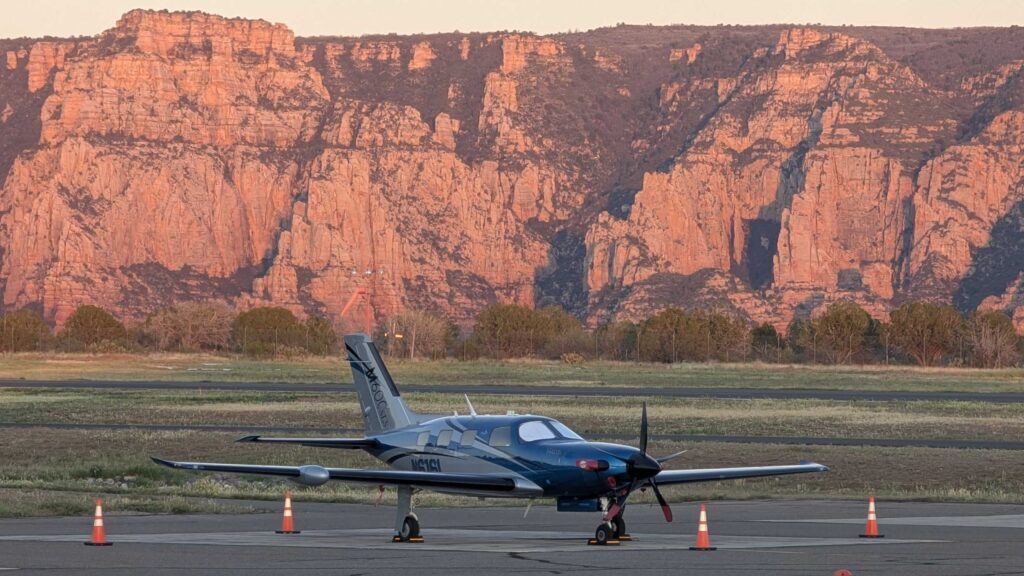
Looking across the tarmac at one of my favorite aircraft, literally out of reach for so many kids. I’d dreamed of flying here so many times – Nova Hall (2026)
Why are we Flying Over Time?
” There are moments in childhood when a dream doesn’t die dramatically. It fades quietly. Mine faded in classrooms.
Not because I lacked imagination, but because of small, repeated signals—subtle redirections and the quiet assumption that aviation belonged to someone else. Other students were steered toward engineering; I slowly absorbed the idea that I wasn’t built for that world.
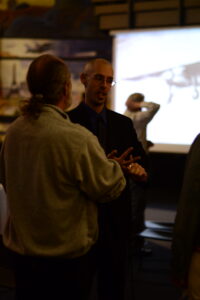
Nova Hall speaking with Kermit Weeks of the Lindbergh Foundation Board of Directors
Yet, airplanes consumed me. I could sit for hours studying wings, fuselages, and the F-16 Falcon. Long before I understood equations, I understood the shapes that created lift. I could see airflow in my mind, but no teacher ever pulled me aside to say, “You belong in this.”
Growing up in Arizona, no adult ever pointed me toward aviation as a real future. I internalized the lie that flight belonged to wealthier, smarter, or simply other people. So, I let the dream drift away.
Then, my father intervened.
An aerospace engineer, he knew the system was wrong about me. Instead of beginning with formulas, he began with curiosity. We studied Jane’s All the World’s Aircraft, learning through stories and real machines. For the first time, STEM felt electric.
One moment changed me: walking with Dad through the university library, surrounded by shelves of aviation research. It felt like discovering a hidden world. Years later, after holding my grandfather Donald Hall’s original engineering papers and blueprints for the Spirit of St. Louis, I finally understood what my father knew all along: Passion comes first.
Not every future engineer looks like one at fifteen. Not every future pilot thrives in a traditional classroom. Often, the difference between a life pursued and a life abandoned is simply one adult recognizing the spark before it disappears.
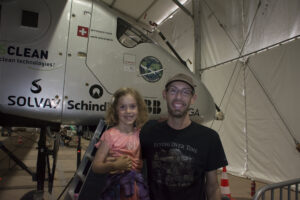
Nova Hall and his daughter in Goodyear, AZ visiting the Solar Impulse aircraft.
That is why we built Flying Over Time. Because somewhere right now, there is a kid staring out an airport fence, convinced aviation belongs to someone else.
And they are wrong.” – Nova Hall, grandson and co-Founder
Help us build the next generation of engineers. Join us at the Spirit99 Gala on July 21st to turn that spark into a future.
Be the adult that recognizes the spark. Support our mission at Flying Over Time and help us bring aviation education to kids who are waiting for an invitation.