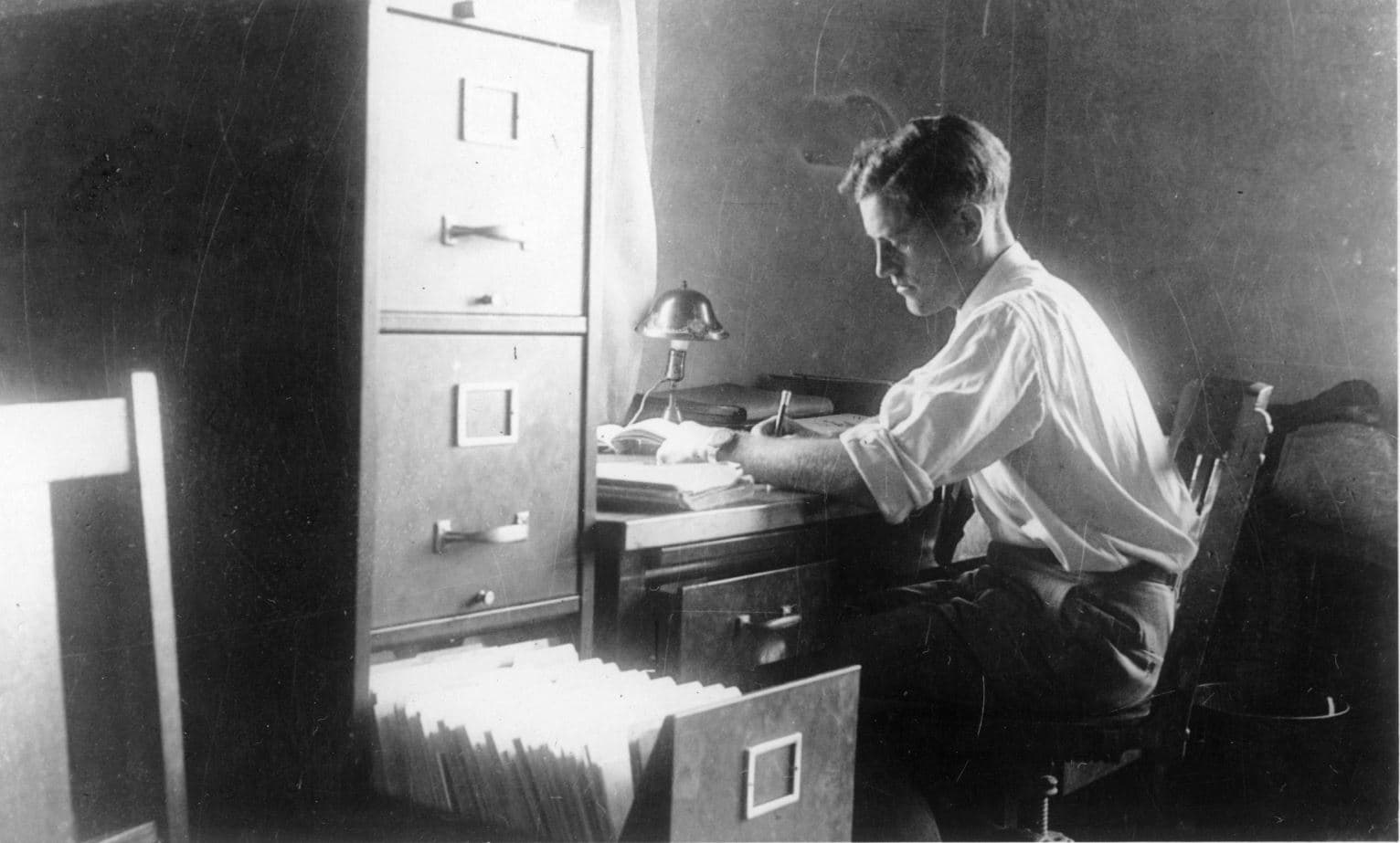
The Estate
Donald A. Hall Estate Collection
The Donald A. Hall Estate Collection contains the definitive, original 1927 engineering blueprints, technical notes, and historical photographic negatives documenting the design and construction of the Spirit of St. Louis (Ryan NYP).
Explore the Estate Collection
948 images from the family-held record. Search captions and descriptions, and open any image to view it in full.
948 images
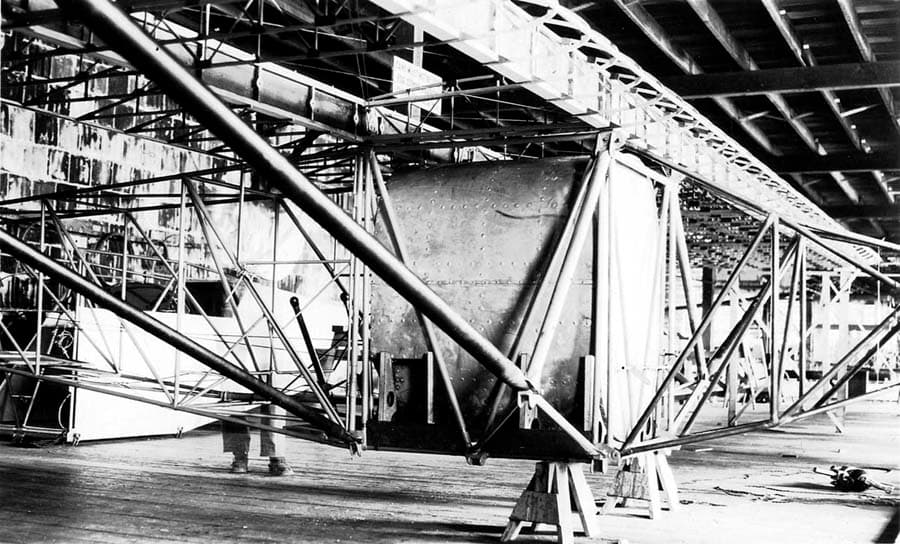
An archival factory negative recording the uncovered fuselage truss and riveted 425-gallon fuel tank of the Spirit of St. Louis. Beneath the frame on the left, a Ryan shop craftsman's legs and boots are visible standing behind the lower longerons, documenting the human presence and workshop scale during the historic 60-day construction.
Donald A. Hall Estate Collection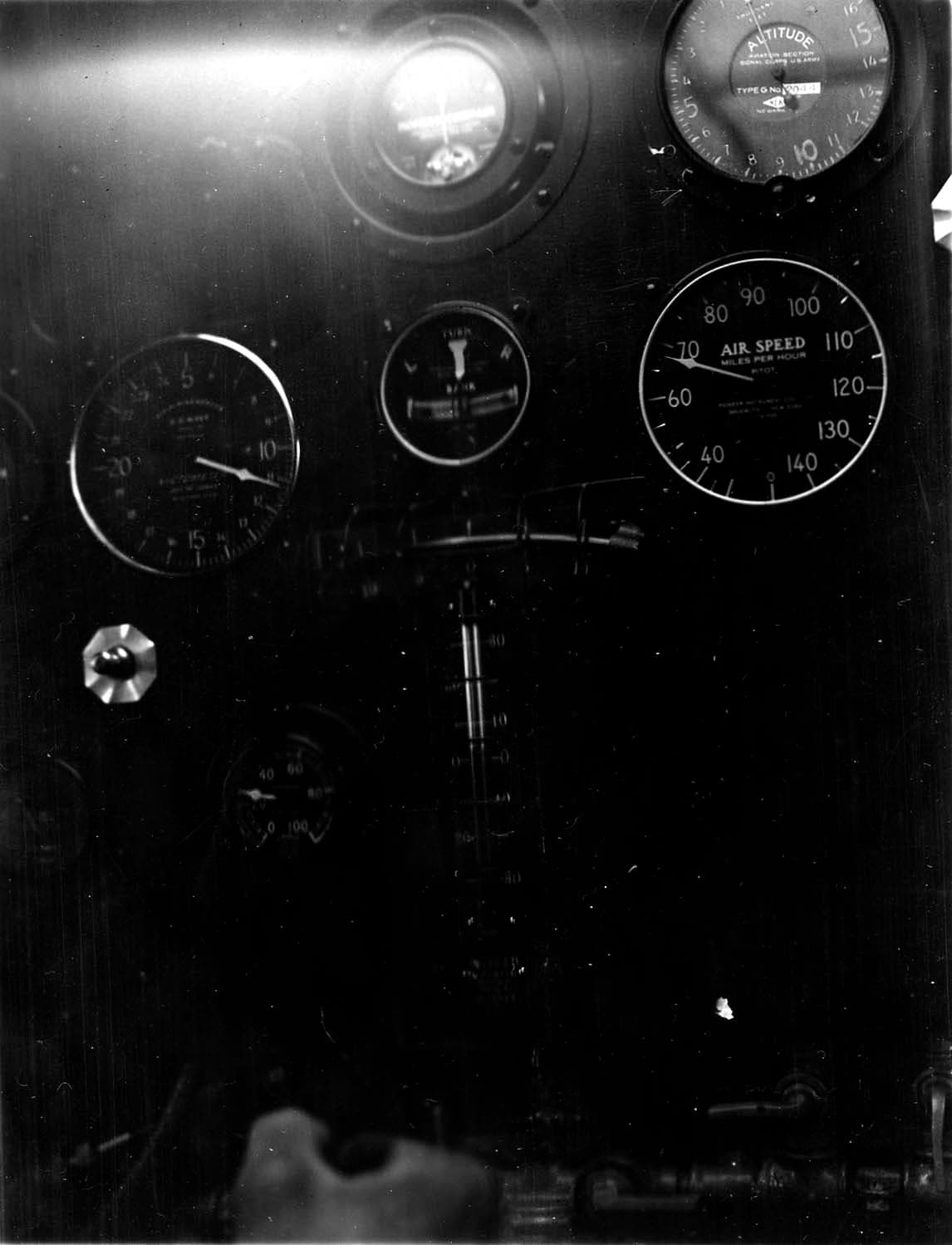
An archival in-flight photograph taken from inside the Ryan NYP Spirit of St. Louis cockpit during flight testing over San Diego, with Chief Engineer Donald A. Hall Sr. perched beside Charles Lindbergh. The exposure details the instrument board at cruise: the Pioneer airspeed indicator reading approximately 98 mph, altimeter registering 1,100 feet, engine tachometer showing 1,600 RPM on the Wright Whirlwind, turn-and-bank indicator centered, and the vertical liquid column gauge. Lindbergh's left hand in a leather flight glove is visible at the lower frame edge near the control stick and throttle.
Donald A. Hall Estate Collection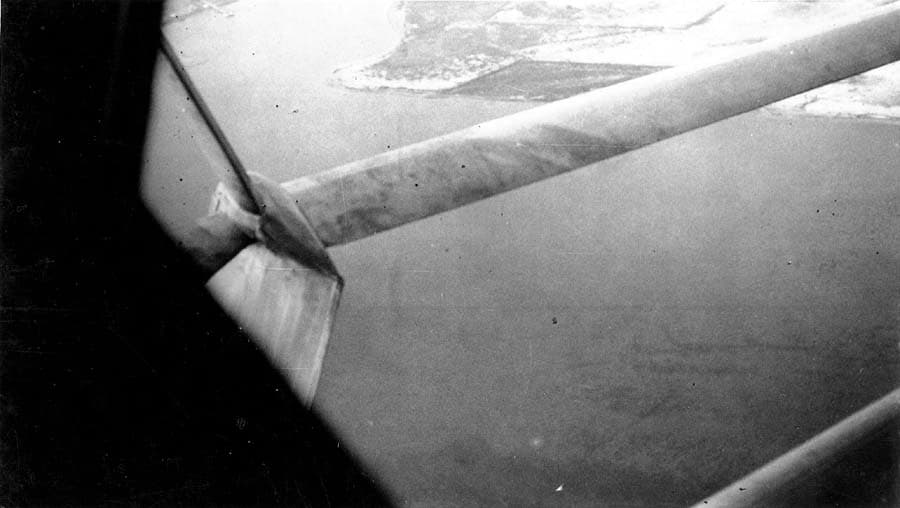
An archival aerial photograph captured by Donald A. Hall Sr. through the right cockpit window of the Spirit of St. Louis during airborne flight trials. Looking downward along the streamlined forward wing lift strut and landing gear jury brace, the image captures the coastal waters, tidal flats, and coastline of San Diego Bay and Point Loma below. This photograph documented the aerodynamic stability and deflection of external wing bracing under dynamic cruising loads.
Donald A. Hall Estate Collection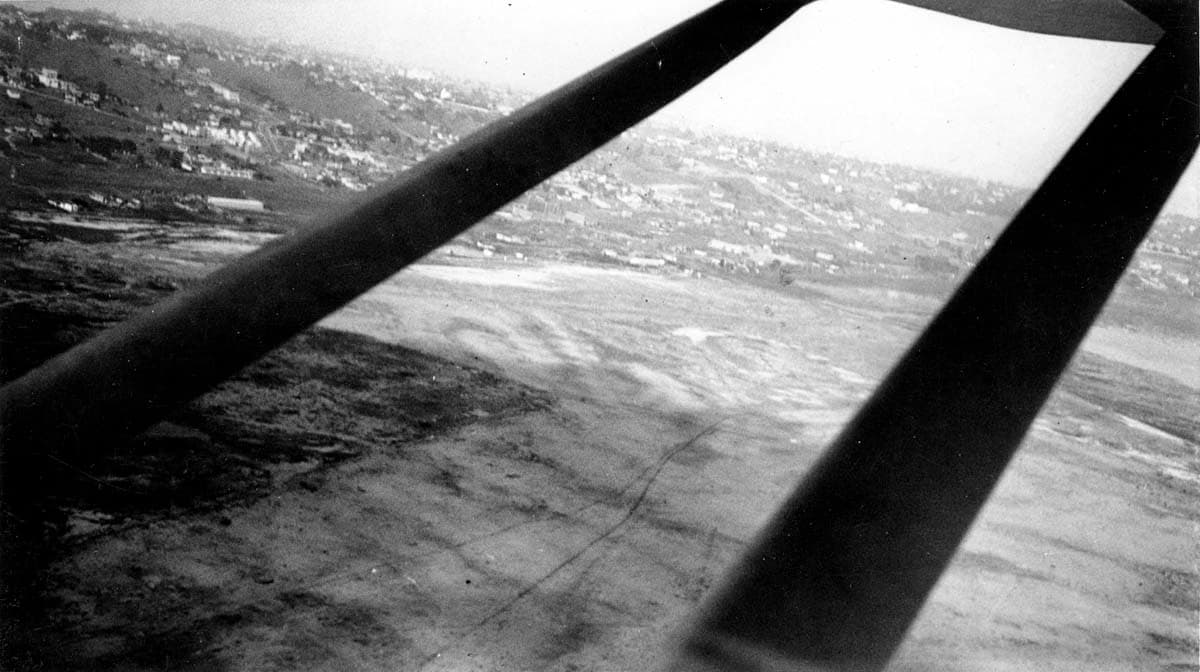
An archival aerial photograph taken from inside the Ryan NYP cockpit looking out between the parallel streamlined wing lift struts down at Dutch Flats airfield and the surrounding San Diego terrain. The view captures the unpaved flight lines, perimeter tracks, and nearby residential hills, documenting the flight test operational area used by Lindbergh and Hall during initial airworthiness and speed trials.
Donald A. Hall Estate Collection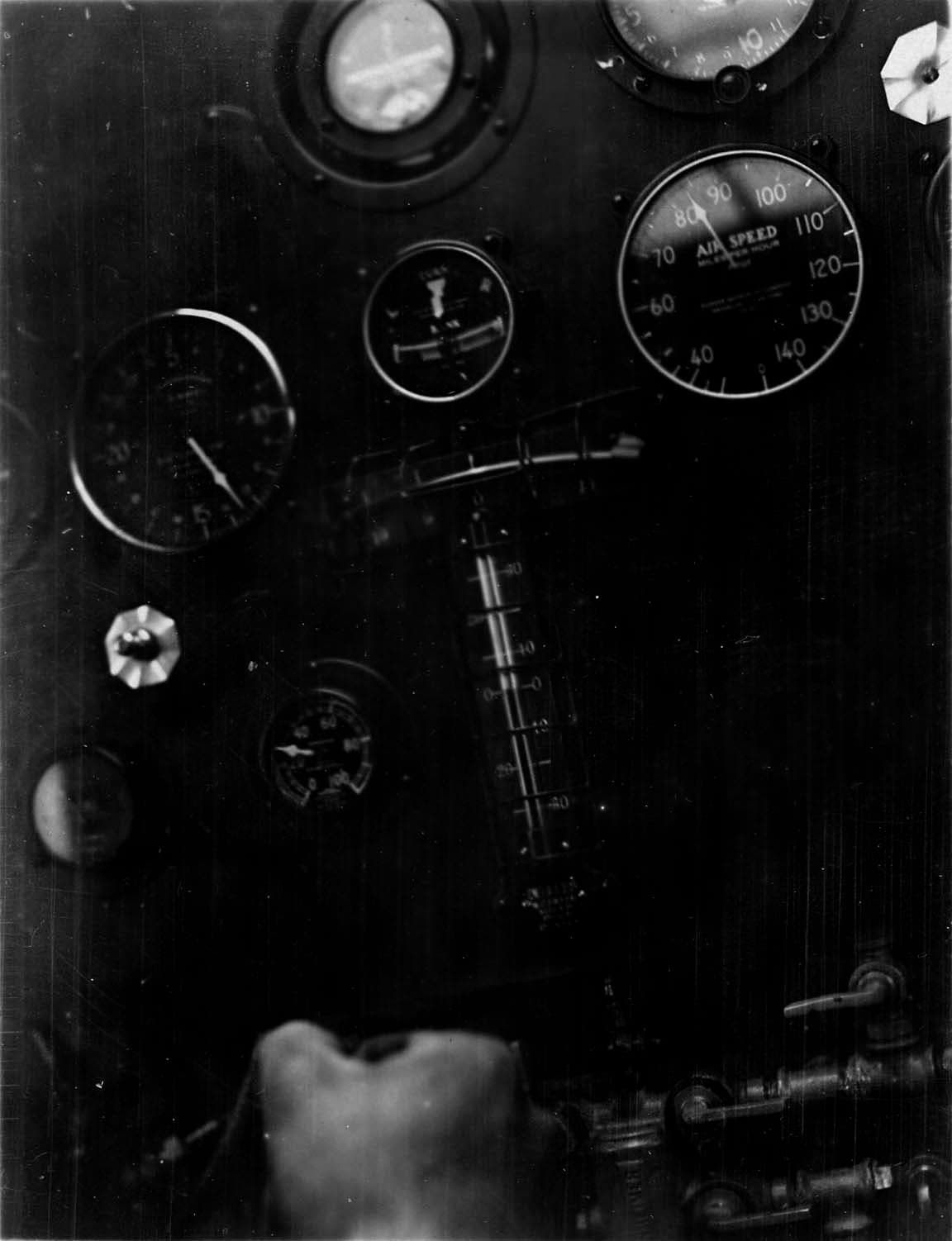
A primary historical in-flight exposure of the Spirit of St. Louis instrument cluster during airspeed calibration trials. The composition prominently captures Charles Lindbergh's left hand wearing a heavy leather aviator gauntlet gripping the base of the control stick. Instruments record cruising flight parameters at 98 mph indicated airspeed, 1,600 engine RPM, and 1,100 feet altitude, providing direct photographic proof of Donald Hall's airborne flight test logging.
Donald A. Hall Estate Collection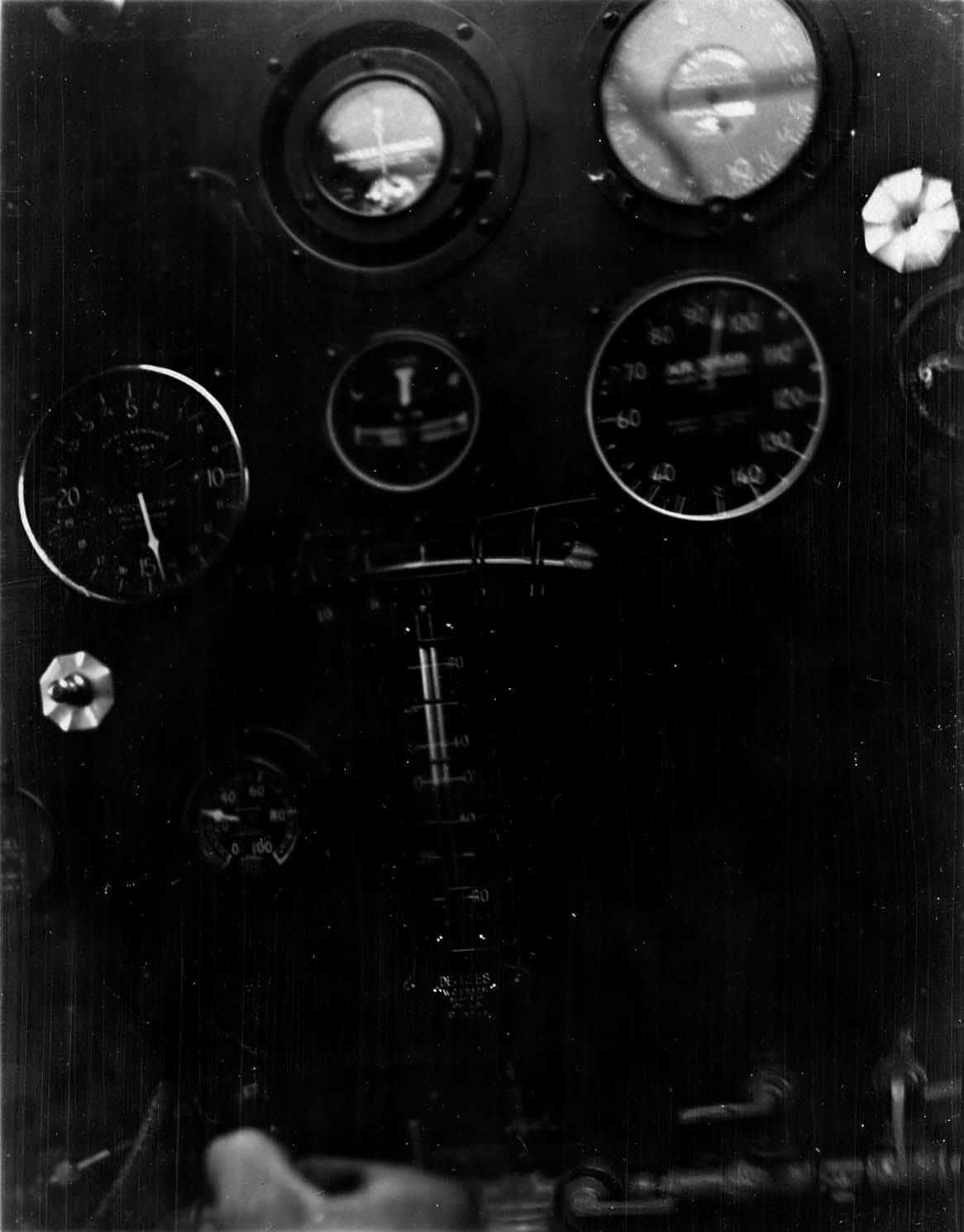
A third archival in-flight photograph of the Ryan NYP instrument cluster taken by Donald A. Hall Sr. during airspeed and compass calibration runs. The exposure details the Pioneer Earth Inductor Compass indicator, altimeter, tachometer, turn-and-bank indicator, liquid column gauge, and lower fuel control valves in operating flight configuration, documenting flight stability and instrument response during trials.
Donald A. Hall Estate Collection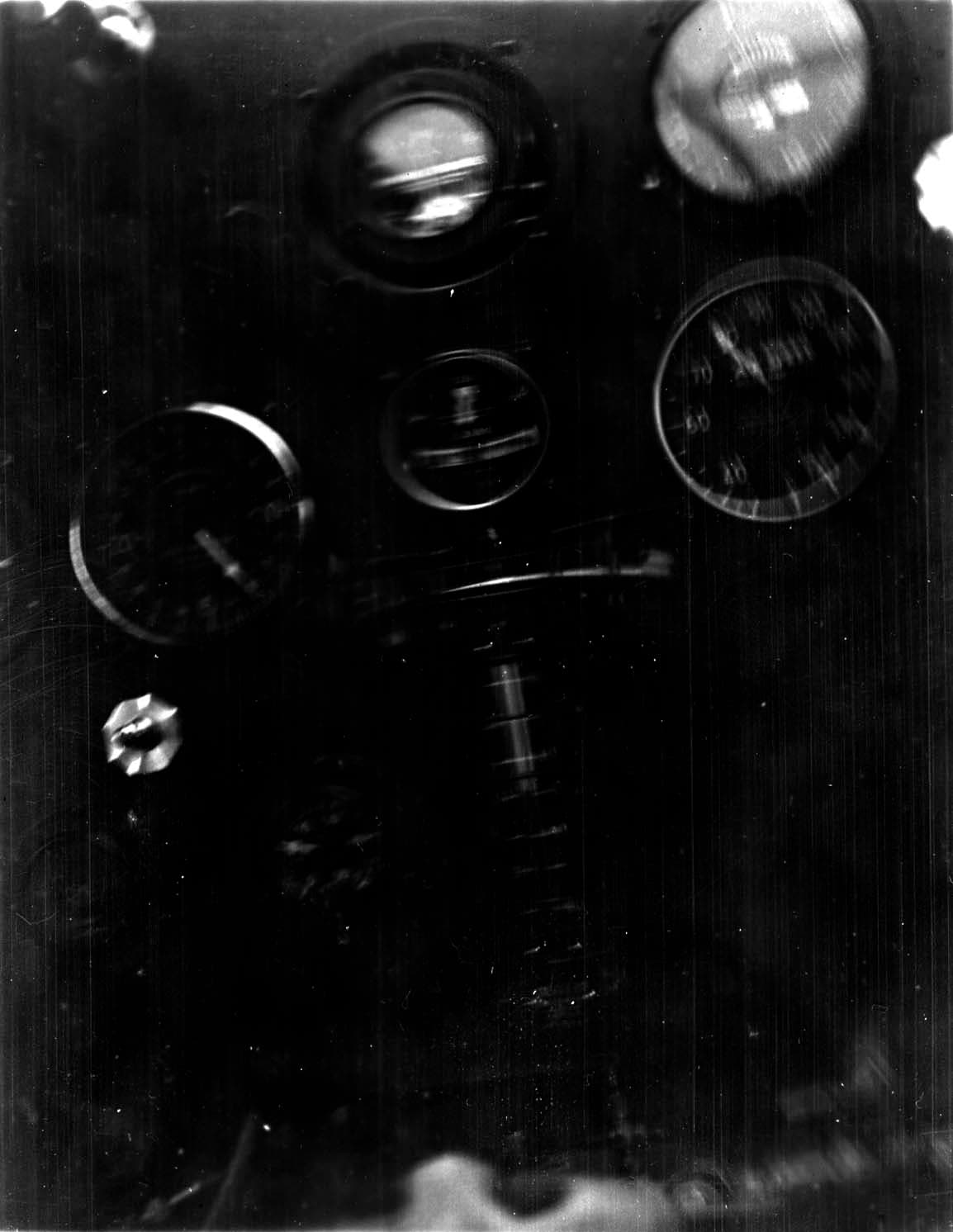
An archival technical construction photograph showing the bare internal aluminum baffle skeleton of the 425-gallon main fuselage fuel tank standing vertically on the Ryan factory floor. The structure reveals a complex matrix of horizontal and vertical sheet baffles pierced with large circular flanged lightening holes engineered by Donald A. Hall to suppress dynamic fuel sloshing across 2,550 pounds of gasoline while ensuring rapid fluid equalization to the bottom sump.
Donald A. Hall Estate Collection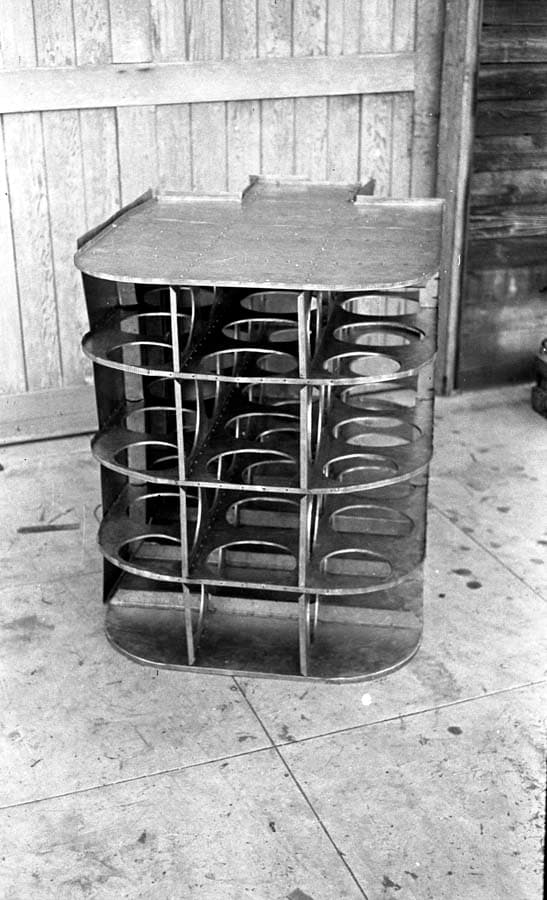
An engineering construction photograph of the internal baffle grid for the 425-gallon main fuel tank resting on wooden sawhorses outside the Ryan hangar doors. Details the interlocking sheet-aluminum bulkheads and flanged cutouts. Donald A. Hall Sr. rejected the first fabricated tank due to excess weld weight, requiring a rebuilt assembly with strict bead deposition per linear inch to satisfy critical gross weight calculations.
Donald A. Hall Estate Collection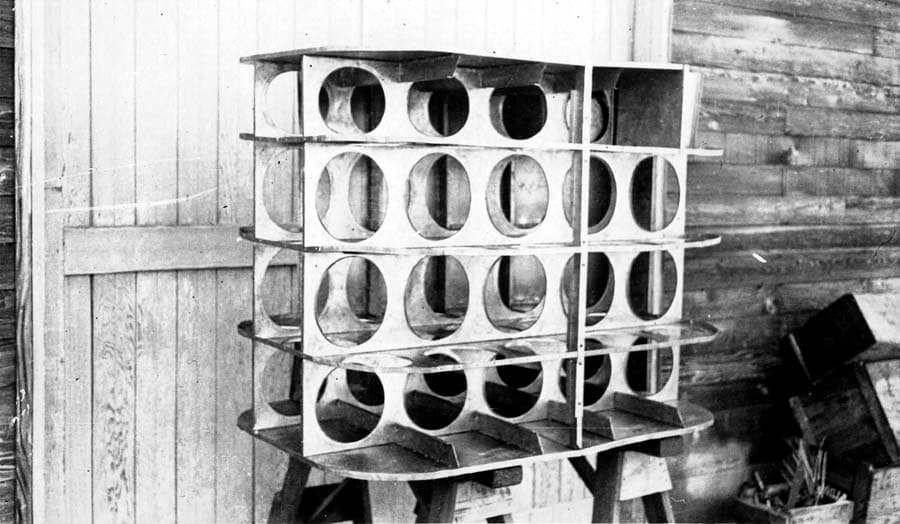
An angled technical study of the internal fuel tank baffle assembly supported on sawhorses. The photograph details the compartmentalized matrix designed to suppress fuel sloshing across 2,550 pounds of gasoline, preventing catastrophic longitudinal center-of-gravity shifts during takeoff and flight. Shows rivet flange spacing along the outer perimeter prior to outer skin welding.
Donald A. Hall Estate Collection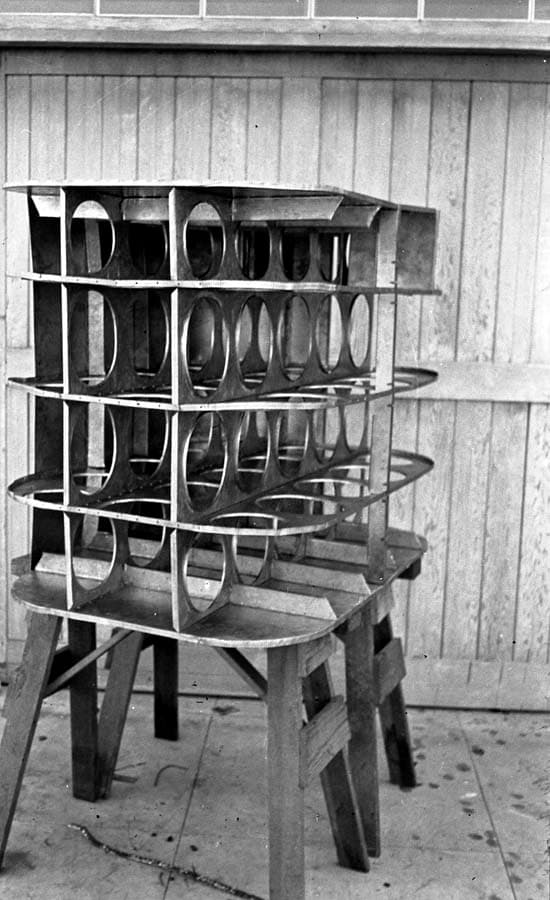
An archival engineering construction photograph showing an angled perspective of the internal aluminum baffle skeleton of the 425-gallon main fuel tank resting on sawhorses outside the Ryan Airlines workshop doors. The matrix of vertical and horizontal bulkheads features flanged lightening holes engineered by Donald A. Hall Sr. to compartmentalize the 2,550-pound gasoline load and prevent violent center-of-gravity shifts caused by dynamic fluid sloshing. This exposure documents the flange spacing and assembly standards established during Hall's weight-saving structural redesign.
Donald A. Hall Estate Collection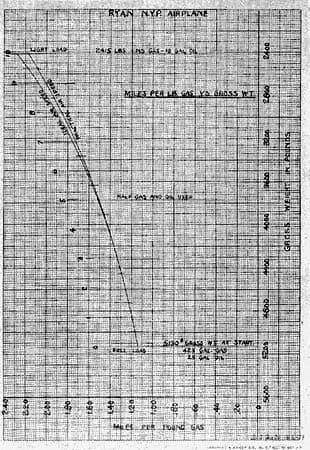
An original hand-plotted technical calibration graph drawn by Chief Engineer Donald A. Hall Sr. titled "RYAN N.Y.P. AIRPLANE / MILES PER LB. GAS VS. GROSS WT." The graph plots gross aircraft weight from full load at 5,130 pounds (425 gallons gas, 25 gallons oil) down to empty weight at 2,415 pounds against fuel economy in miles per pound of gasoline. By establishing both Ideal Air Speed and Practical Air Speed curves, this chart provided the baseline fuel management data utilized by Charles Lindbergh during the 1927 transatlantic crossing.
Donald A. Hall Estate Collection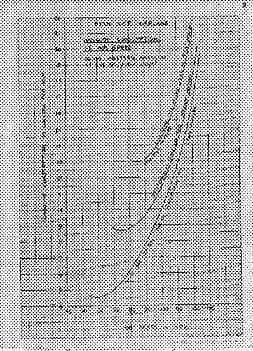
An archival master engineering graph (designated Sheet 2) titled "RYAN N.Y.P. AIRPLANE" from Donald A. Hall Sr.'s technical design files. The chart plots indicated airspeed in miles per hour (from 40 to 140 mph) against engine horsepower required across multiple gross weight configurations ranging from full overload to empty weight. These aerodynamic curves established the power requirements for the Clark Y wing and were subsequently incorporated into Hall's authoritative NACA Technical Note 257.
Donald A. Hall Estate Collection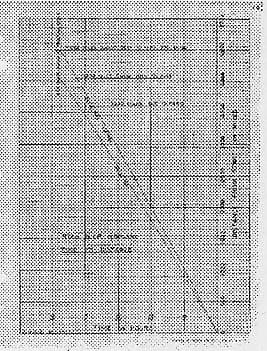
A primary technical calculation graph from Donald A. Hall Sr.'s files plotting gross aircraft weight and fuel burn against elapsed flight time in hours. The chart tracks the continuous weight reduction of the Spirit of St. Louis from 5,130 pounds at takeoff down to empty reserve weight across an endurance envelope extending beyond 40 hours. This mathematical projection proved that the Ryan NYP possessed sufficient fuel capacity to overcome head winds, bad weather detours, and navigational drift.
Donald A. Hall Estate Collection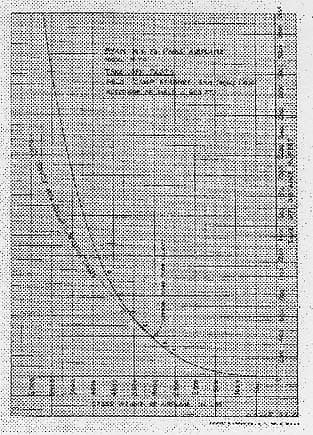
A master flight-test calibration graph titled "RYAN N.Y.P. (PARIS) AIRPLANE / MODEL NYP / TAKE-OFF TESTS / FIELD: CAMP KEARNY, SAN DIEGO, CALIF. / ELEVATION OF FIELD: 650 FT." Plotted by Donald A. Hall Sr. from empirical flight trials conducted on May 4, 1927, the chart graphs ground run distance in feet against gross weight in pounds. Hall's extrapolated curve predicted a 2,300-foot takeoff roll at design gross weight (5,135 lbs) and 2,450 feet at maximum overload (5,250 lbs), providing the critical performance figures Lindbergh used for takeoff from Roosevelt Field.
Donald A. Hall Estate Collection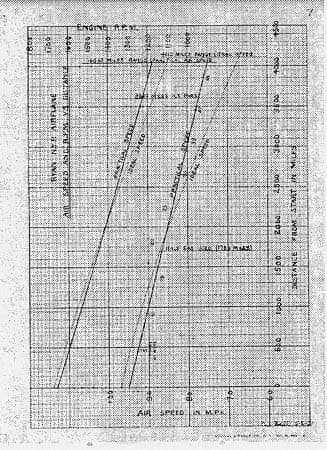
An indispensable master flight management chart (Sheet 7) titled "AIR SPEED AND R.P.M. VS. DISTANCE" drawn by Chief Engineer Donald A. Hall Sr. The graph defines the transatlantic operational flight schedule across 4,110 miles, plotting airspeed and Wright Whirlwind RPM against distance from start. It instructed Lindbergh to gradually throttle back the engine from 1,750 RPM and ~102 mph at heavy takeoff weight down to 1,500 RPM and ~78 mph as fuel burned off, optimizing engine longevity and fuel economy.
Donald A. Hall Estate Collection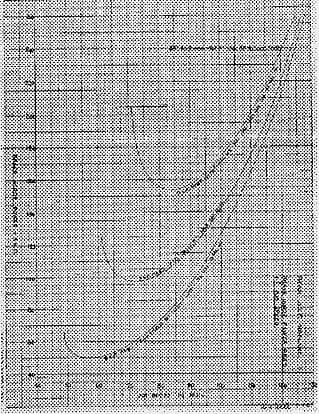
An archival engineering calculation graph from the Donald A. Hall Estate Collection plotting brake horsepower required against indicated airspeed in miles per hour. Plotted across varying gross weight increments, the chart defines the aerodynamic drag polar and rate of climb boundaries for the Ryan NYP monoplane, documenting Hall's structural and aerodynamic optimization of the high-aspect-ratio wing.
Donald A. Hall Estate Collection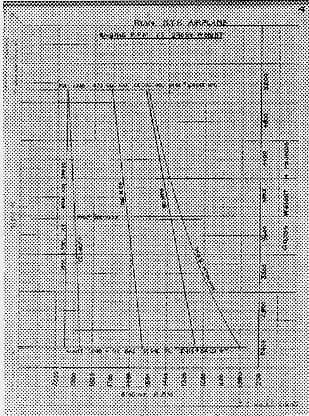
A technical flight-test chart titled "RYAN N.Y.P. AIRPLANE / ENGINE R.P.M. VS. GROSS WEIGHT" calculated and hand-drawn by Donald A. Hall Sr. The graph plots gross aircraft weight from 5,130 pounds down to 2,415 pounds against the required engine RPM necessary to maintain level flight. This diagram provided the pilot with an exact operational guide to reduce propeller speed as fuel weight burned off, ensuring maximum fuel conservation.
Donald A. Hall Estate Collection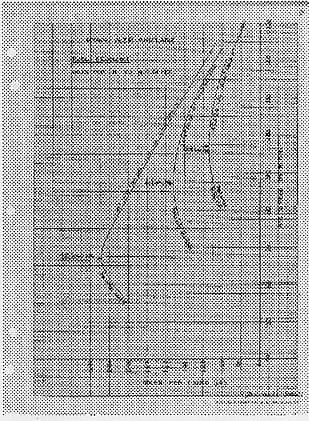
A primary mathematical graph from Donald A. Hall's design portfolio plotting fuel mileage efficiency (miles per pound of gasoline) against indicated airspeed. Plotted for full load, intermediate loads, and light load, the parabolic curves identify the specific optimum cruising velocity required to extract maximum nautical miles per pound of fuel consumed throughout the transatlantic flight.
Donald A. Hall Estate Collection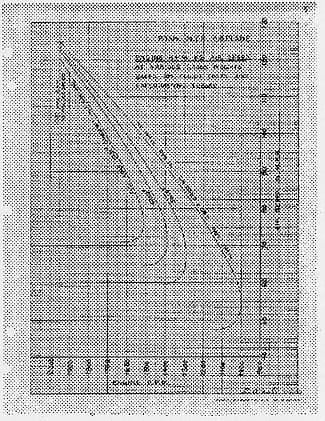
An archival master technical graph signed in the lower margin by Donald A. Hall ("DAH"), titled "RYAN N.Y.P. AIRPLANE / BRAKE HORSE POWER VS. ENGINE R.P.M." The chart details engine power output and specific fuel consumption rates across rotational speeds from 1,000 to 1,900 RPM under varying operational conditions. These engine performance curves served to calibrate the cockpit tachometer and throttle quadrant for the historic flight.
Donald A. Hall Estate Collection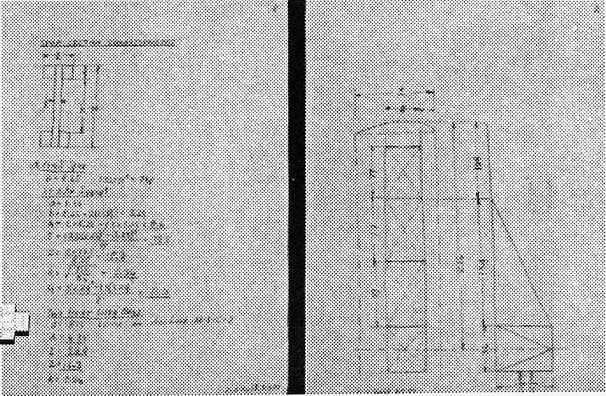
An original mathematical calculation sheet from Donald A. Hall Sr.'s master engineering design files for the Ryan NYP Spirit of St. Louis. The document details the structural cross-section geometry of the built-up Sitka spruce wing spar, illustrating flange thickness, web depth, and centerline dimensions. Hall's handwritten calculations derive the cross-sectional area, moment of inertia, section modulus, and allowable fiber stress under ultimate load conditions, proving the structural integrity of the extended 46-foot high-aspect-ratio wing under overload takeoff weights.
Donald A. Hall Estate Collection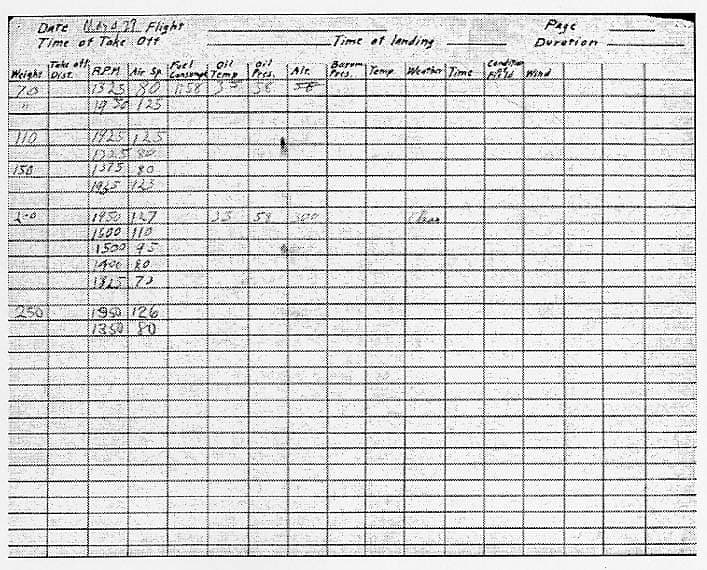
The original primary flight test log sheet recorded by Donald A. Hall Sr. and Charles Lindbergh during heavy-load trials at Camp Kearny, San Diego, on May 4, 1927. Organized in ruled columns, the sheet documents incremental fuel loading trials at 70, 110, 150, 200, and 250 gallons. Hall logged engine RPM settings from 1,325 to 1,950 RPM, calibrated airspeeds from 72 to 127 mph, oil pressure, oil temperature, and atmospheric conditions, establishing the baseline aerodynamic performance table for the transatlantic flight.
Donald A. Hall Estate Collection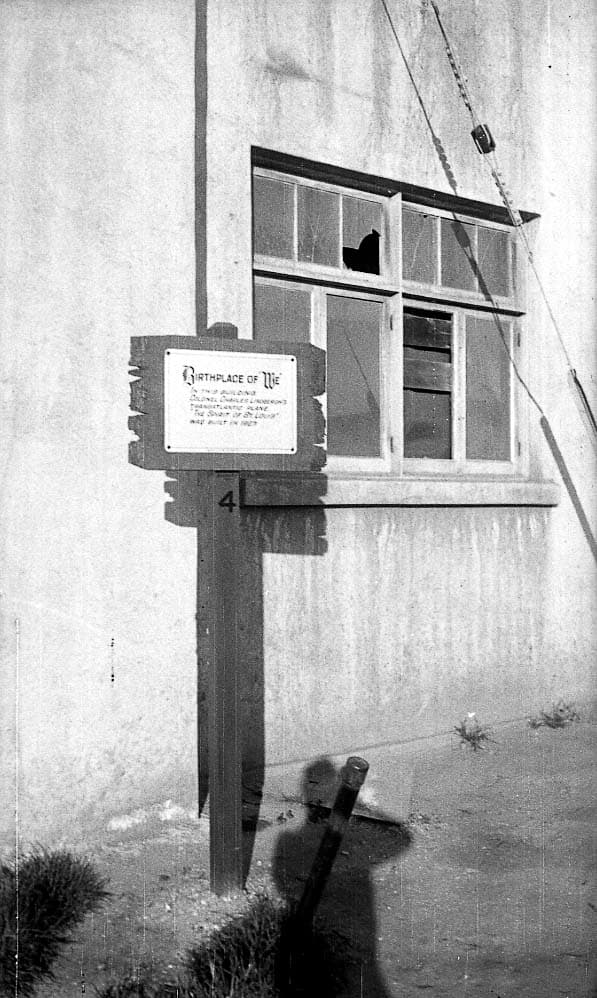
An archival documentary photograph capturing the exterior of the former Ryan Airlines factory on Juniper Street in San Diego, originally a fish cannery building where the Spirit of St. Louis was designed and fabricated in 60 days. The view shows weathered concrete walls, boarded-up lower windows, a shattered upper window pane, and a commemorative wooden signpost erected outside reading: "BIRTHPLACE OF 'WE' / IN THIS BUILDING / COLONEL CHARLES LINDBERGH'S / TRANSATLANTIC PLANE / 'THE SPIRIT OF ST. LOUIS' / WAS BUILT IN 1927".
Donald A. Hall Estate Collection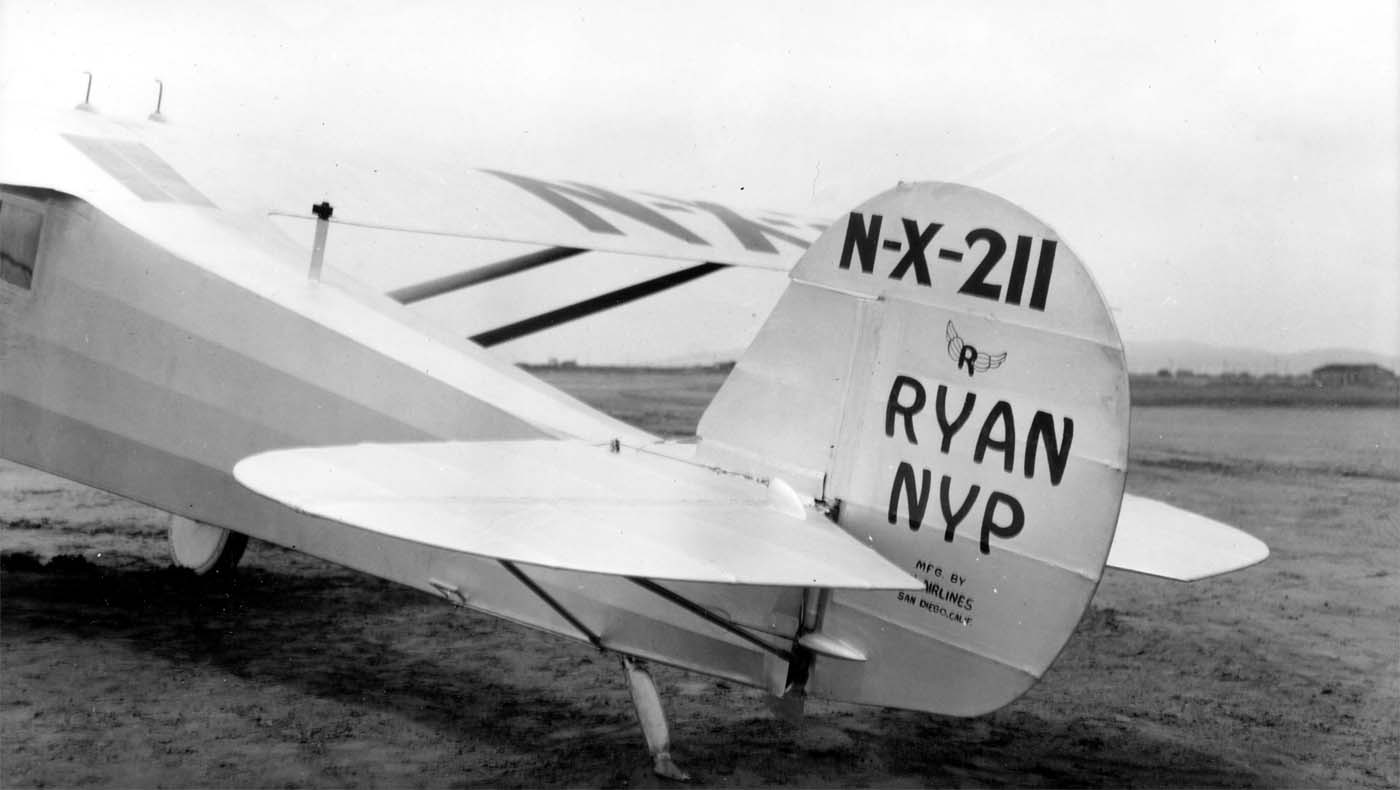
An archival flightline photograph detailing the tail surfaces and empennage of the Ryan NYP Spirit of St. Louis (N-X-211) parked at Dutch Flats, San Diego. The view details the fabric-covered balanced rudder, the winged Ryan trademark logo, and official stenciling: "N-X-211 / RYAN / NYP / MFG. BY / RYAN AIRLINES / SAN DIEGO, CALIF.". The photograph also captures the horizontal stabilizer structure, elevator hinge line, tail skid shock strut, and upper wing registration letters.
Donald A. Hall Estate Collection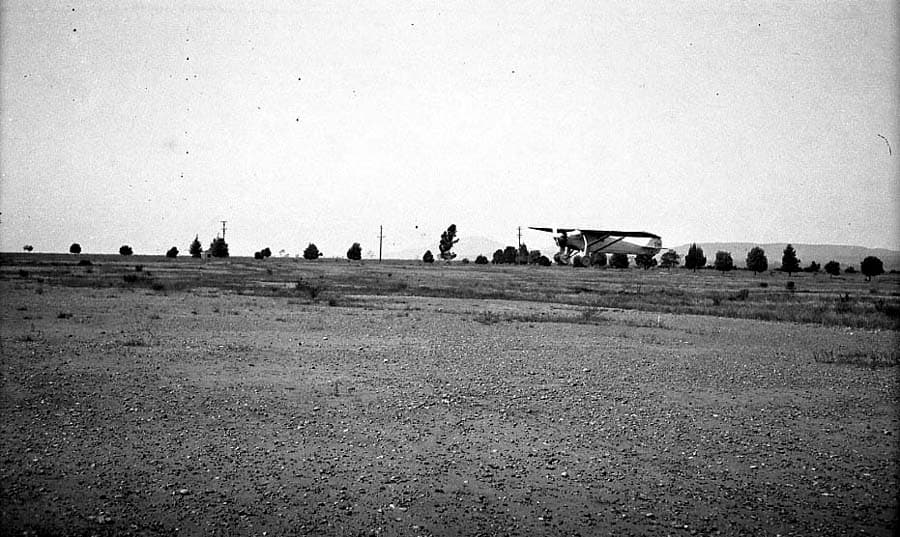
An archival engineering photograph documenting the Spirit of St. Louis airborne during flight testing at Camp Kearny, San Diego. Captured flying in ground effect just above the unpaved surface, the image records Donald Hall and Charles Lindbergh conducting speed and takeoff distance trials across the open military field, selected because its extended run allowed safe testing of high-overload fuel weights that could not be operated from Dutch Flats.
Donald A. Hall Estate CollectionResearch, permissions, and image requests
Contact the collection for credits, rights information, and permission to reproduce images.